21/10/2026 08:25
Public Catalogue or Customer Samples? YouTube Playlist Privacy for Cambodian Upholstery Shops

A Cambodian upholstery shop may film fabric textures, cushion construction and completed chairs for several different reasons. Some clips help new buyers understand the workshop’s services. Others show one customer a proposed finish or record work awaiting approval. Trouble begins when these clips enter the same promotional playlist without a clear decision about their audience. Before sharing a catalogue through social posts or discussing promotion with an SMM provider, check both the collection and its contents. This workflow explains how to build a useful public viewing route, separate customer-specific material and test the result. All shop scenarios below are hypothetical illustrations, not customer stories or measured results.
1. Give the catalogue one customer-facing purpose
Start with a question a new buyer needs answered. For an upholstery workshop, that might be: “What should I compare before asking for a chair-recovering quotation?” A collection answering that question could show fabric texture, seam finishes and removable cushion covers. It does not need every video the workshop has recorded. A narrow purpose makes it easier to decide whether a clip belongs in the public collection.
In a hypothetical Phnom Penh shop, the owner prepares a catalogue for people comparing dining-chair finishes. A customer’s sofa inspection is irrelevant even though it demonstrates skilled work. Keep it outside this collection. Write a short internal rule: include approved demonstrations that explain available chair-finishing choices. That rule gives the person maintaining the playlist a practical admission test and prevents a useful catalogue from gradually becoming an unsorted workshop archive.
2. Understand the two separate visibility decisions
YouTube provides Public, Unlisted and Private settings for playlists. Public collections are suitable for open discovery; unlisted collections can be watched and shared by people holding their links. Private is appropriate for an owner’s internal collection rather than an openly shared catalogue. YouTube’s playlist privacy guide documents these options and their visibility differences.
The individual videos also have access settings. A private video does not become openly watchable simply because it sits in a public playlist. Conversely, hiding a collection does not make an otherwise public video confidential. Review the container and each item separately. Think of the playlist as the catalogue index and each video as a separate demonstration with its own audience decision. The practical question is therefore twofold: should visitors find this collection, and should they watch every demonstration it contains?
3. Sort footage by purpose before touching settings
Make a short inventory with a video title, subject, intended audience, approval status and next action. Use ordinary descriptions such as “generic piping demonstration,” “customer fabric comparison” or “unfinished repair assessment.” Avoid putting customer phone numbers or delivery addresses in this inventory if the marketing team does not need them. The purpose is to make selection easier, not to duplicate the workshop’s order records.
Review the whole clip, including speech and background objects. A clean opening shot can be followed by a spoken customer name, a quotation sheet on the bench or a reflection of a home interior. In a hypothetical Siem Reap workshop, a useful cushion demonstration also includes a customer’s delivery note. The team chooses to film a fresh generic demonstration. That creates a reusable promotional asset without depending on repeated attempts to conceal details from a project recording.
4. Choose unlisted only when resharing is acceptable
Unlisted is useful for convenient link-based viewing, but it is not a confidentiality agreement. YouTube explains that recipients can reshare unlisted links. Its video privacy guidance also notes that an unlisted video may appear in search if someone adds it to a public playlist. Do not use the word “private” casually when explaining an unlisted sample to a customer.
Apply a simple decision test: would the shop and customer be comfortable if this clip reached someone outside the original conversation? If yes, an unlisted sample may suit the purpose. If no, reconsider the footage and sharing method. For example, a close-up of an anonymous fabric sample may be suitable for easy sharing; a walkthrough of a customer’s furnished home calls for a different decision. Record the intended audience before distributing anything so staff do not later treat a convenient sample link as an approved marketing asset.
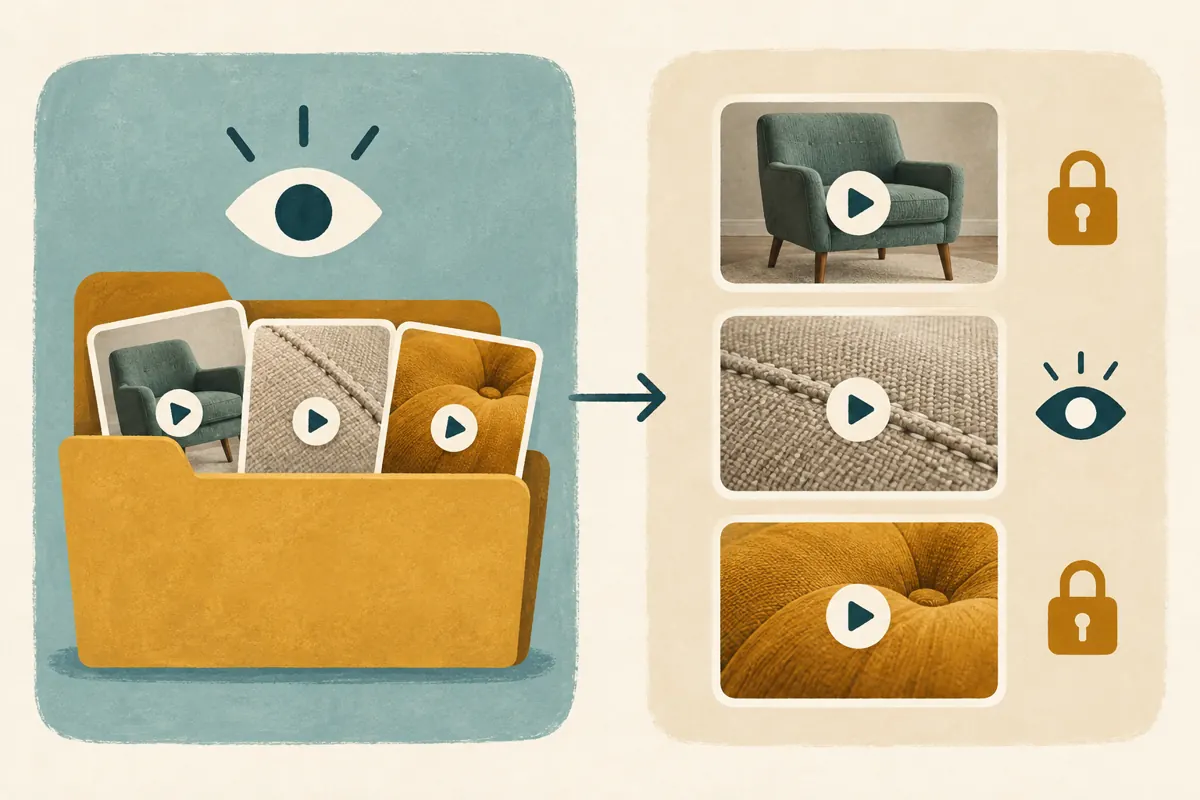
5. Build the public collection from approved demonstrations
Use a title that describes the decision the collection supports, such as “Dining-Chair Upholstery: Fabric and Finish Examples.” Prepare Khmer wording when that suits the intended customers, retaining genuine fabric or model names where necessary. Describe the examples honestly: a filmed sample illustrates appearance and construction, while actual availability and suitability require confirmation. Avoid implying that every displayed finish is immediately available.
To change playlist visibility on a computer, YouTube’s official instructions direct owners to YouTube Studio, then Content and Playlists. Open the relevant playlist’s Details, choose Visibility and save the selected setting. Make this change after reviewing the membership of the collection. For the hypothetical chair catalogue, the owner selects only approved generic clips, sets the collection for public viewing and records who completed the review. That creates an identifiable release decision instead of relying on whoever last edited the playlist.
6. Test the collection as an ordinary visitor
An owner’s successful playback is an incomplete test because the owner may have access that a customer lacks. Open the intended public link in a signed-out browser session and work through the collection. Check the first video, each later item and any enquiry instruction. Ask a colleague to repeat the test on a phone without using the channel’s management account.
Have the tester describe what they understood. Can they distinguish a fabric comparison from a completed customer order? Can they identify which finish they want to ask about? Can they find the shop’s approved contact route? Record the observed problem precisely: “The second item cannot be watched in the visitor test” is more useful than “YouTube is broken.” Investigate that item’s access and availability before changing the whole collection. Do not expose customer-specific footage merely to remove a playback obstacle.
7. Make the viewing route useful for Cambodian enquiries
A catalogue should help viewers ask a better question. Give each demonstration a recognizable sample reference and explain the feature being shown in language customers understand. Where useful, distinguish fabric colour from texture and decorative piping from a structural seam. These are content choices, not promises that a playlist will receive more reach. Keep spoken explanations consistent with captions and the information staff use when replying.
In a hypothetical Battambang shop, a viewer likes the appearance of a removable cushion cover but assumes the quoted work includes new foam. The workshop adds a clear explanation of what the demonstration shows and what must be assessed separately. Its enquiry instruction asks for the sample reference, furniture type and a suitable photograph sent through the approved contact route. Exact home addresses and private order details are unnecessary in public comments. This makes the catalogue useful even before any additional promotion is considered.

8. Apply a policy check before considering an SMM service
The supplied je-smm.com catalogue includes the exact label “YouTube Like ~ Max 5k ~ 5k/days ~ Instant ~ 𝗥𝗘𝗙𝗜𝗟𝗟 30D”. Its name identifies a YouTube-like service, but the brief provides no supporting description. Treat the remaining wording as catalogue claims rather than verified delivery conditions. It does not establish playlist support, Cambodian audience origin, authentic interest or suitability for this workflow.
YouTube’s fake engagement policy prohibits artificial increases in views, likes, comments and other metrics. It also explains that a hired promoter’s actions can affect the channel. Do not proceed with a method that violates that policy, and do not make restricted footage public to satisfy a service requirement. Purchased engagement is not evidence of genuine interest, sales, ad delivery or Cambodian users. A useful panel review can end with no order: document the unsuitable method, preserve the approved catalogue and pursue compliant promotion instead.
9. Fix mistakes at the level where they occur
Common mistakes include mixing customer samples with evergreen demonstrations, assuming a playlist setting controls every video, and testing only while signed in as the owner. Another is judging approval from the thumbnail alone. A thumbnail showing plain fabric says nothing about the names, paperwork or spoken details later in the recording. Make full playback part of the review for unfamiliar material.
If the wrong clip enters the catalogue, pause further distribution and identify what needs correcting. Review the collection membership, the clip itself and the links already used in promotional posts. Removing an item from a catalogue is an organizational action; assess its individual access separately. Keep a brief correction note explaining what changed and why. If an approved demonstration is merely unavailable, investigate before replacing it with a superficially similar clip that shows a different finish. A working link still needs accurate content.
10. Maintain the catalogue around real business changes
Assign one person to review additions and another, where staffing allows, to perform the visitor test. Repeat the review when a demonstration changes, a featured material becomes unavailable or the shop starts promoting a different service. A small, maintained collection is easier to explain than a large archive with uncertain relevance. Preserve a record of the intended audience and the latest review date.
Evaluate usefulness through actual enquiry content. Note whether customers can identify the sample they mean, whether staff repeatedly explain the same missing condition and whether the contact route works. A request for a chair assessment is different from a confirmed booking; record them separately. If viewers repeatedly misunderstand what a demonstration includes, revise that explanation before expanding promotion. The practical aim is an accessible catalogue that supports informed conversations while keeping customer-specific work under deliberate control.

Frequently asked questions
Should a public catalogue contain customer-specific sample videos?
Only after a deliberate review establishes that the footage is appropriate for that audience and the necessary permission exists. A sample recorded to resolve one customer’s question has a different purpose from a reusable demonstration. Often the clearest solution is to film an anonymous example specifically for the catalogue.
Can I use one playlist for public examples and unfinished project reviews?
Separate collections are easier to maintain because they have different audiences and approval rules. Mixing them creates extra checking whenever someone adds a clip or shares the link. Keep the public collection focused on approved examples, and review the access requirements of project material independently.
What should I do if a customer cannot watch one item?
Ask which item failed and what message appeared, without requesting their login details. Reproduce the issue through a visitor test, then check that video’s availability and intended audience. If it was never approved for general viewing, replace the catalogue entry with an appropriate demonstration rather than broadening access automatically.
Does a service labelled YouTube Like promote the entire playlist?
The supplied service name does not establish that capability, and its description is empty. Do not infer accepted targets or delivery behaviour from a category label. More fundamentally, assess the proposed method against YouTube’s rules before considering any order; a clearer target does not make artificial engagement permissible.
How can a small workshop tell whether the catalogue is helping?
Review the questions it receives. Customers identifying a finish accurately or supplying the information needed for an assessment can indicate that the explanations are useful. Record these observations without claiming the playlist caused every enquiry. Keep confirmed orders, exploratory messages and platform engagement counts as separate records.
Explore the current service catalogue, create an account, or ask a specific question through support tickets.
- YouTube Help: Change playlist privacy setting
- YouTube Help: Change video privacy settings
- YouTube Help: Fake engagement policy
Prepared with AI assistance. Illustrations explain the workflow and do not represent customer results.