20/10/2026 08:12
Which Reed Goes Under? TikTok Playback Reviews for Cambodian Basket-Weaving Shops

A basket-weaving video can look beautiful while leaving its most useful detail unexplained. The maker folds a reed, turns the basket, and reveals a neat rim—but the viewer never sees where the loose end went. For Cambodian workshops promoting handmade baskets or weaving lessons, that gap matters. A customer may want to understand the finish before asking about a product, while a beginner needs to follow the movement. Reviewing playback speed helps distinguish a rushed action from missing footage. This workflow turns that distinction into practical filming decisions before the shop spends more time or money promoting the clip.
1. Choose the question the demonstration must answer
Start with one observable question, such as: where does the loose reed enter the rim? That gives the reviewer something concrete to find. A broad aim like showing craftsmanship leaves too much room for approval based on attractive lighting or music. Write down what the viewer should be able to point to after watching: the entry gap, the direction of the reed, and its final position.
In a hypothetical example, a Siem Reap basket workshop wants to explain a tucked rim on a small storage basket. Its video is intended for shoppers comparing finishes, rather than a complete weaving lesson. The shop therefore needs to show the tuck clearly without teaching every earlier stage. If the same footage will promote a class, the review must also check whether a beginner can understand the starting position. Decide which audience the clip serves before judging its pace.
2. Separate viewing speed from the recorded action
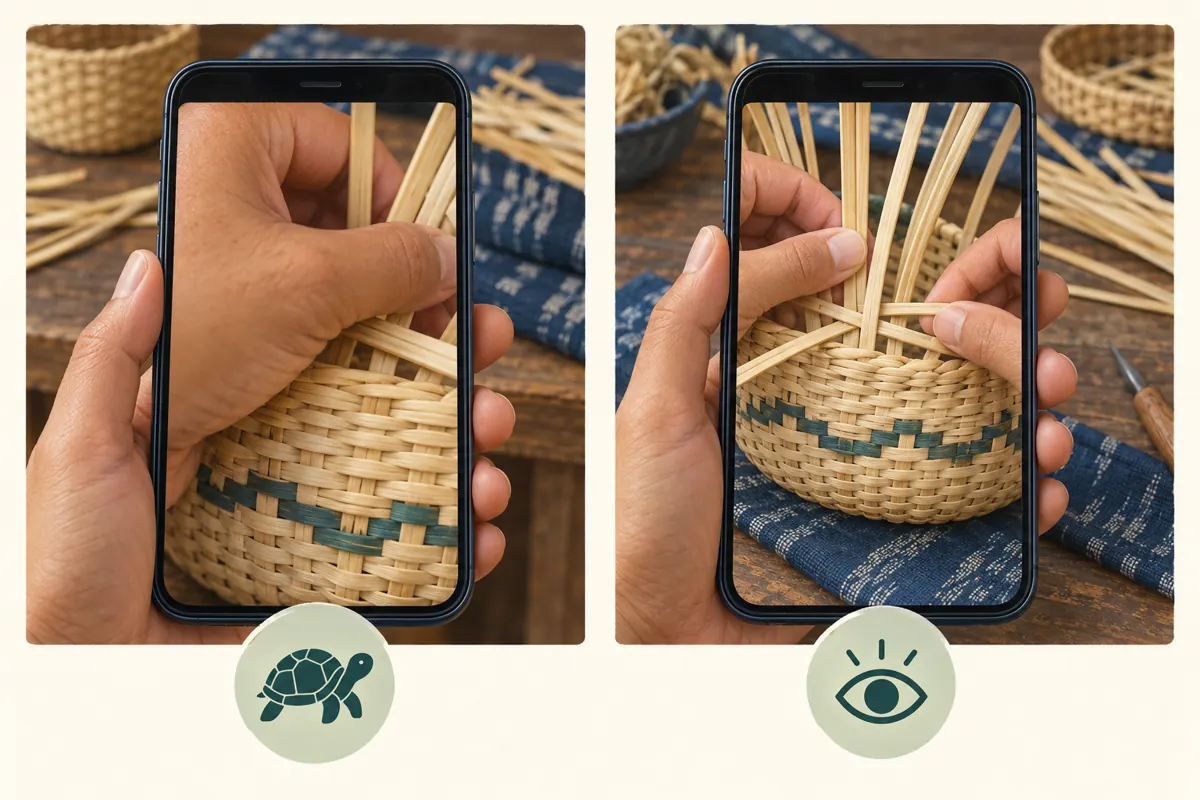
TikTok’s official Inclusion and Belonging Guide describes a viewing control reached by long-pressing a video and selecting Playback speed. Use the options actually available on the reviewing device. This is a playback check; it does not establish that the original demonstration was recorded at a natural pace. An already accelerated sequence remains an edited representation even when the reviewer slows it down.
Watch once at normal playback before changing anything. Note what you understood and where you lost the movement. Then review the troublesome passage more slowly if the control is available. Finally, return to normal playback and ask whether an ordinary first-time viewer receives enough information. If the option is absent, review the original recording in a player that supports slower playback. Treat that as a footage check, and separately inspect how the published TikTok video appears.
3. Film the starting position, movement and result
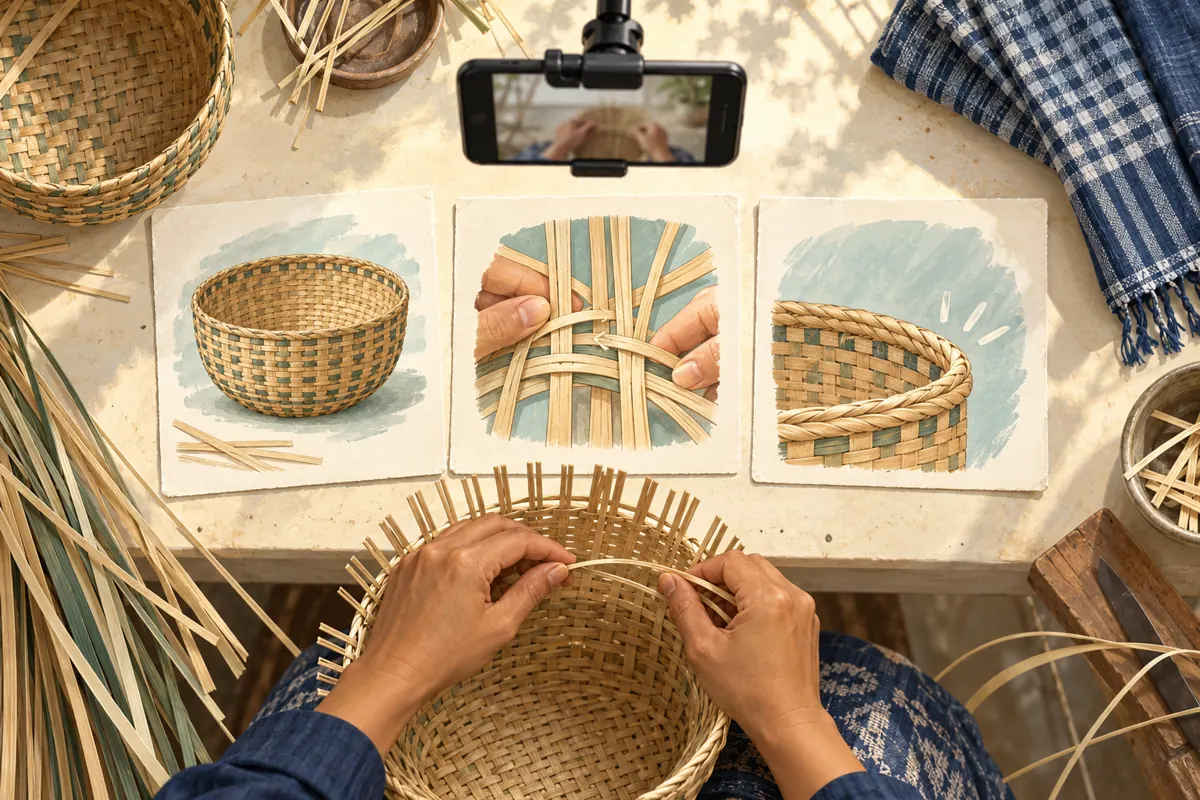
Prepare three views around the chosen question. First, establish the basket’s orientation and the loose reed. Second, show the complete movement through the junction. Third, hold the finished position long enough for viewers to compare it with the beginning. These views can form one continuous recording or a carefully connected sequence. The important point is that the viewer can track the same piece throughout.
Use a plain surface that contrasts with the material. Keep decorative baskets outside the close-up if their patterns compete with the working reeds. Position the phone so the maker’s wrist does not cover the entry gap. Ask the maker to pause before starting, complete the action naturally, and pause again afterward. Record an additional angle while the setup is available. A second view is often more useful than repeatedly slowing an obstructed first view.
4. Diagnose the gap during the slower review
A slower replay can expose several different problems. The action may be visible but too brief to follow. A hand may hide the crossing point. The camera may lose focus as the basket moves closer. An edit may jump directly from a loose end to a finished tuck. Record the actual problem instead of writing only that the video feels fast. Each diagnosis calls for a different correction.
In the hypothetical workshop example, slower playback reveals that the reed disappears behind the maker’s thumb. That is an obstruction problem, so slowing the final video would merely display the obstruction for longer. Move the camera or repeat the action with a clearer hand position. If the entire path is visible but rushed, a deliberately paced repeat may solve it. If the action is absent between cuts, return to the source footage or film it again.
5. Match the narration to what viewers can see
Listen to the explanation at normal playback after the visual check. A phrase such as put this here asks viewers to infer both the object and destination. Prefer language that identifies the visible relationship: guide the loose end beneath the next upright strip. Have the maker confirm that the explanation describes the technique accurately. Do not invent a universal weaving rule from one shop’s demonstration.
For a Cambodian audience, use the language the intended customers understand and have a fluent reviewer check any Khmer wording used in the video. Keep product names consistent between speech, captions and replies. If English is also needed, avoid crowding both languages over the junction. A separate version may be clearer. Review the video without sound as well: a viewer should still recognize the material, the movement and the finished detail without decoding a dense block of text.
6. Preserve an honest sense of time and workmanship
A short promotional video does not need to show every repetitive movement. It does need to make its omissions understandable. If you compress a long weaving stage, identify it as an abbreviated sequence and restore a clear view for the detail being explained. Do not imply that an entire basket takes only the duration of the video to make. Avoid attaching a production-time claim unless the workshop has evidence for that specific claim.
Likewise, a clear close-up is not a durability test. Showing a tucked end does not establish how much weight the basket can carry, how it tolerates moisture, or how long it will last. Keep the promotional message tied to what the footage demonstrates. Product specifications and care advice should come from the workshop’s verified information. This keeps the video useful without turning a simple craft explanation into unsupported product proof.
7. Ask a fresh viewer to explain the movement
The maker already knows where the reed goes and may unconsciously fill in missing information. Ask a colleague who did not edit the video to watch once at normal playback. Then ask them to point out the entry gap and describe where the end finishes. Avoid leading questions such as did you see it go under that strip? The answer should reveal what the video communicated without coaching.
Record the misunderstanding in ordinary language. For example, the reviewer thought the reed passed behind the rim when it actually passed through a visible gap. That observation points toward a better angle or a short explanatory hold. It does not justify claiming that all customers are confused. After revising, repeat the specific comprehension check. Keep the approved original recording and final version together so future edits do not accidentally restore the unclear sequence.
8. Make the SMM-panel decision after the clarity review
For readers evaluating je-smm.com, one supplied public listing is named “TikTok - Views ~ 𝐃𝐫𝐨𝐩 0% ~ Max Unlimited ~ 1M-100M/Days ~ INSTANT”. Its title identifies it as a views listing, but the supplied description is empty. The wording is not independent evidence of delivery speed, retention, audience origin or genuine attention. It offers no basis for concluding that Cambodian shoppers will understand this basket demonstration.
TikTok’s Integrity and Authenticity rules prohibit services that artificially increase engagement and describe enforcement against inauthentic activity. Check that policy before considering a panel purchase, and decline services that conflict with it. Purchased engagement cannot demonstrate genuine interest, sales, ad delivery or Cambodian users. For this workflow, spend effort first on clear footage and genuine feedback. A service title or delivered count cannot answer whether the viewer saw which reed went underneath.
9. Give the clearer demonstration a useful next step
Once the clip answers its question, connect it to an appropriate enquiry. A product-focused demonstration might invite viewers to ask which basket sizes use the shown rim. A class-focused demonstration might invite questions about beginner sessions. Keep the invitation consistent with what the shop actually offers. Do not imply that a class, delivery area or custom-order option exists unless the business has confirmed it.
In the hypothetical Siem Reap example, the shop pairs the video with a current photograph of the available basket and an invitation to ask about dimensions. Staff answering enquiries should know which finish appears in the clip. If a viewer asks for a different material or shape, explain the difference before quoting. Keep private delivery details in the shop’s appropriate enquiry channel rather than encouraging customers to post addresses publicly beneath the demonstration.
10. Review questions and avoid the usual shortcuts
After sharing, look for specific questions about the demonstrated detail. A request to see the underside may suggest a useful follow-up angle. A question about dimensions belongs in product information. Praise is welcome, but it does not establish understanding or purchasing intent. Keep genuine enquiries, confirmed orders and any service-delivery records separate so a change in a visible count does not become an unsupported business conclusion.
Common mistakes include approving only the slowed version, assuming a viewer will discover playback controls, and replacing missing footage with more captions. Another is asking the maker to judge a first-time viewer’s experience alone. Use a simple decision rule: keep the clip when the action is visible and understandable; revise the explanation when the visual evidence is clear but its meaning is ambiguous; reshoot when the essential movement is hidden, blurred or missing. Promote the version that passes that review.

Frequently asked questions
Should every weaving demonstration use slow motion?
No. Start with a clear recording at a natural working pace. A brief slower passage can help viewers examine a complicated movement, but slowing the whole clip may make simple stages unnecessarily long. Let the comprehension review identify where additional viewing time is useful, and preserve enough context to connect the detail to the basket.
What if Playback speed does not appear on the reviewing phone?
Use the controls available on that device and review the original recording separately in a suitable player. Do not build the demonstration around a control every customer must find. The final clip should explain its essential movement at normal playback, with an additional clear view when necessary.
Can a higher view count show that the demonstration is clear?
A count alone cannot tell you whether viewers understood the reed’s path. Ask a fresh reviewer to describe it and examine genuine questions for recurring confusion. Purchased views provide no reliable evidence of comprehension, Cambodian audience origin or buying interest, and artificial engagement raises platform-policy concerns.
Should an unclear video always be deleted?
First assess the consequence. A merely incomplete explanation may be addressed with a clearly identified follow-up. A materially misleading product claim needs a correction that viewers can actually find. Check where the original link has been shared before deciding how to handle it, and avoid continuing to promote footage you know creates a false impression.
Can these article illustrations replace the shop’s product footage?
No. They are AI-generated editorial illustrations explaining the review process, not evidence of a particular workshop, product or weaving technique. Film the shop’s actual materials and workmanship for customer-facing demonstrations, and verify the technique with the maker before presenting it as instruction.
Explore the current service catalogue, create an account, or ask a specific question through support tickets.
- TikTok Inclusion and Belonging Guide — video accessibility and playback controls
- TikTok Community Guidelines — Integrity and Authenticity
Prepared with AI assistance. Illustrations explain the workflow and do not represent customer results.